by Khaleel Nizami
By carefully decoding a quarter – century of Royal discourse, a profound geopolitical narrative emerges: how a resource – limited state in a volatile region leverages the power of political language to forge domestic cohesion and project an unwavering moral stance on the global stage.

On Jordan’s Independence Day, the true measure of the state does not begin with the ephemeral scenes of celebration in the streets or the ceremonial raising of flags, Rather, the real question begins with the profound meaning that Jordan has meticulously accumulated across a quarter-century of speeches, official positions, and strategic political choices, While national occasions give a state its visible, celebratory image, the tools of Political Discourse Analysis reveal its deeper, foundational identity,What exactly does Jordan want to say about itself? What core principles does it repeat across decades until they become an inseparable part of its national DNA? And what message does it carry to the international community when its geography narrows under pressure, yet its existential questions expand?
By reading a comprehensive sample of His Majesty King Abdullah II’s speeches-extending from the early years of his constitutional reign to the pivotal addresses of 2024 and 2025- one does not encounter mere protocol texts or empty ceremonial rhetoric.
Instead, these speeches serve as a detailed roadmap of Jordan’s meaning in a turbulent and unpredictable era. They reveal a state that refuses to define itself through historical commemoration alone, choosing instead the path of active continuity, It builds its presence at home through institutions, systemic reform, and public trust, while projecting its influence abroad through the relentless defense of Palestine, Jerusalem, peace, and international law.

What this discourse ultimately reveals is that independence is not a static date to be passively recalled on a calendar, It is a dynamic meaning that is continuously reproduced, It is not a day suspended in collective memory, but a daily, grueling capacity to keep the state cohesive, to preserve its independent voice, and to firmly define its place in a world order that rarely grants small states the luxury of absence.
In the King’s discourse, Jordan emerges as a highly self-aware actor: a state that intimately understands the limits of its natural resources, yet outright refuses to accept a limited or marginalized regional role.
It reads itself internally as an ongoing institutional project, and it presents itself to the world as an immovable moral and political position – one that does not retreat from the Palestinian cause and absolutely refuses to compromise the fundamental meaning of a just and lasting peace.
Internal Legitimacy: Independence as a Permanent Test and a Moral Covenant
Since 1999, the year King Abdullah II assumed his constitutional powers, a clear and deliberate duality has appeared in the Royal discourse,Internally, Jordan consistently recurs as a state of institutions, army, parliament, gradual reform, stability, and equal citizenship. Externally, it recurs as a fierce advocate for Palestine, Gaza, international law, and shared humanity.
This duality does not imply a fractured identity or two contradictory discourses. Instead, it reveals a single, unified structure of a state attempting to protect itself from within while simultaneously preserving its meaning and relevance abroad,The internal front requires unbreakable cohesion so that the region’s perpetual crises do not consume it, while the external environment imposes a duty on Jordan that strictly prohibits political silence,In reading the official Independence Day speeches, sovereignty is framed not as a completed victory, but as a permanent, ongoing test, Independence does not end with the historic declaration of sovereignty; that is merely where it begins.

After the declaration, the much harder questions arise: How does sovereignty transform into functioning institutions? How does the concept of a homeland translate into the rule of law, reliable public services, schools, an army, and a parliament? How does independence transition from a dusty political document into a daily, tangible feeling of security for the citizen?
Here we find the deeper philosophical undercurrent of the Royal discourse, Independence is treated as a continuing responsibility, Returning to the official archive, in the 2007 Independence Day speech, His Majesty addressed Jordanians on an occasion he described as embodying freedom, belonging, and sacrifice for the pursuit of a dignified life.
This specific language reveals that independence, in Jordan’s political lexicon, cannot be divorced from human dignity, Freedom is not presented as an abstract, philosophical concept, but rather as something tethered to a citizen’s ability to see the state as a protective framework for their life, not as an alienated or distant authority,In later addresses, especially during the 74th Independence Day in 2020 and the 76th in 2022, a new dimension of this discourse emerged, In times of severe crisis, independence is stripped of its purely celebratory nature and becomes a severe test of national endurance.
In 2020, as the world collapsed under the weight of the coronavirus pandemic, Jordan faced unprecedented questions about the role of the state in moments of collective fear, The King’s speech addressed Jordanians as the “sons and daughters of the homeland” – a phrase carrying immense social and political weight,The state was not addressing scattered, isolated individuals, but rather a broad, unified national family, Through this linguistic framing, independence evolved into a “moral covenant” between the leadership and the society.
The “Speeches from the Throne” give this internal reading particular constitutional depth, When the King opens the ordinary sessions of the National Assembly, he does not address a festive crowd; he addresses the legislative authority,These speeches reveal how sovereignty moves from a patriotic symbol to an active parliament, an accountable government, and the rule of law. The vocabulary morphs to meet the era-from consolidating trust in the early 2000s, to modernization in 2024 and 2025.
Perhaps the most critical juncture in this internal discourse occurred in 2011, As the Arab Spring plunged the region into profound existential turmoil, with regimes collapsing and societies fracturing, the Royal language revealed a highly precise Jordanian equation: Reform is an absolute necessity, but the collapse of the state is not reform,Change is required, but descending into chaos is not a path to freedom. In this philosophy, the state is not the enemy of freedom so long as it preserves the law,Therefore, “stability” in the Jordanian context is not stagnation or stillness; it is the vital prerequisite for safe political movement, It means the state must continuously change itself without ever losing its cohesion.
The External Compass: Sovereignty as a Moral Stance Exposing the Global Order
However, Jordan in the King’s speeches is never complete from within alone, When the discourse shifts outward, the vocabulary transitions dramatically, Palestine, Jerusalem, Gaza, international law, and human rights surge to the forefront, Jordan does not define itself solely through its internal institutions; it defines itself through its unyielding position on the question of regional justice, The state that prioritizes the rule of law domestically invokes international law fiercely in its foreign policy.
This dynamic was unmistakably clear in His Majesty’s address before the United Nations General Assembly on September 24, 2024, Standing at the UN podium amidst global turmoil, the King did not merely speak about the tactical realities of the war on Gaza, He elevated the discourse to question the very legitimacy of the international order when its institutions fail to protect civilians. The speech placed the Palestinian tragedy within a chilling, broader inquiry: What remains of international law if it cannot protect the weakest among us?
This point exposes the very essence of Jordan’s external discourse, Jordan does not posture as a global superpower possessing instruments of military or economic coercion,Instead, it speaks from the position of a state wielding the immense legitimacy of principle, Its strength is not the power to impose, but the power to remind, It constantly reminds the world that peace built on the ignorance of justice is a fragile illusion, and that international law loses its foundational meaning the moment it becomes selective.
Yet, this discourse is highly sophisticated and adaptable, In contrast to the UN speech, the King’s address at the Arab Summit in Bahrain on May 16, 2024, utilized an entirely different linguistic toolkit, Addressing Arab leaders, the discourse abandoned the abstract appeals to international law and instead utilized the language of shared Arab responsibility, brotherhood, and the urgent need for a unified regional stance, The core issue – Gaza – remained identical, but the platform dictated a shift in the angle of argument, This indicates a mature political discourse that does not robotically repeat itself, but strategically changes its tools of persuasion according to the audience while maintaining its steadfast constants.
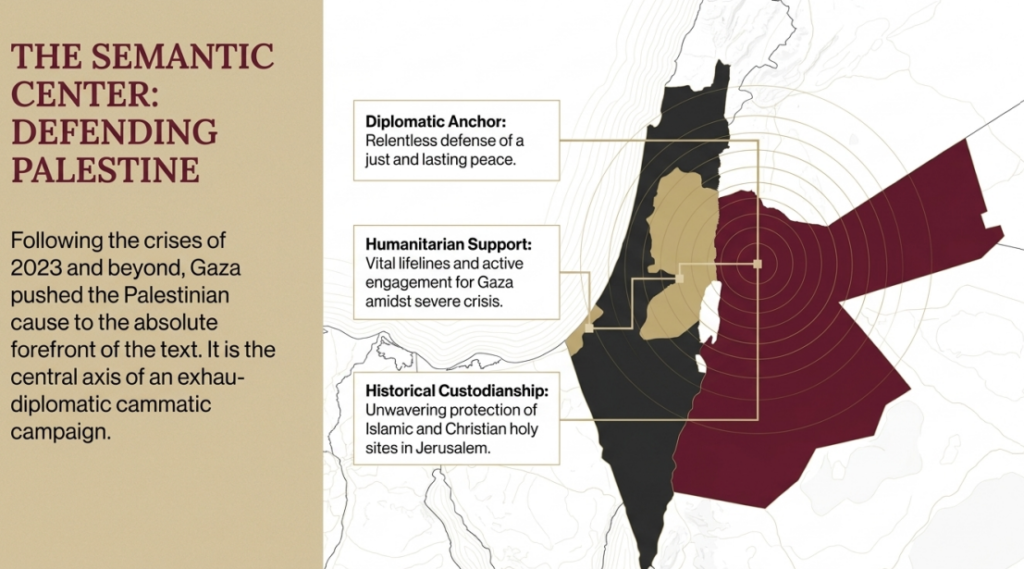
Following the devastating events of 2023, Palestine did not suddenly appear in the Royal discourse – it has always been the anchor – but the war on Gaza pushed this constant to the absolute forefront of the text, Gaza became the “semantic center” of Jordan’s diplomatic language, The crisis did not alter Jordan’s moral compass; it starkly revealed it.
The year 2025 further deepened this trajectory, The sequence of international speeches – spanning the 80th UN General Assembly, the Conference on the Two – State Solution, and the European Parliament – demonstrated that Palestine is not a passing theme, but the central axis of an exhaustive diplomatic campaign, Here, Jordan’s external voice becomes an integral component of its sovereignty, An independent state is defined not only by the borders it protects but by the uncomfortable truths it is willing to speak when speech becomes politically costly.
Crucially, the external discourse refuses to be wholly consumed by geopolitical conflict, On April 2, 2025, His Majesty addressed the Global Disability Summit in Berlin, The inclusion of this speech is analytically vital because it pulls Jordan’s image beyond traditional Middle Eastern conflict management and into the realm of universal human rights, The state that demands justice for Palestine at the UN also advocates for the dignity of persons with disabilities in Europe.
This philosophical consistency proves that Jordan demands justice not because it serves a specific political file, but because the state seeks to align itself with a comprehensive, universal understanding of human dignity.
The Philosophy of Discourse: Crafting a Role Beyond the Limits of Geography
Synthesizing these texts reveals the grand strategic equation of the Jordanian state: internally, independence means fiercely protecting social cohesion and building institutions; externally, it means possessing an independent stance that refuses to dissolve into the shifting balances of global powers, Independence for Jordan is not isolationism, It is the ability to actively engage the world from an independent footing, Jordan simply cannot physically distance itself from the Middle East’s cascading crises, but it actively refuses to become a chaotic extension of them.

This is the incredibly difficult tightrope upon which the Royal discourse walks: how to remain at the beating heart of an inflamed region without losing the image of a stable, functioning state; and how to be a country with limited material resources without ever accepting a limited diplomatic role, The speeches prove that Jordan builds its geopolitical standing using metrics that cannot be quantified on a balance sheet, True strength here stems from continuity, historical legitimacy, geographic centrality, and the unparalleled ability to formulate a coherent, rational position when surrounded by irrationality.
In a region littered with the remnants of collapsed states and fractured societies, mere survival is elevated to a supreme political value, But the Royal discourse does not settle for mere survival; it insists on giving that survival profound meaning, In the Royal speeches, Jordan continually attempts to hold two vital threads together: constructing the internal front while carrying a heavy moral burden abroad, The Jordan that passionately advocates for Gaza and Jerusalem on international stages returns home to focus intensely on youth empowerment, economic modernization, and army readiness.
A state obsessed with foreign policy while neglecting its domestic front will inevitably collapse; conversely, a state entirely inward – looking loses its geopolitical relevance, Reading Independence Day through the lens of political discourse fundamentally shifts the analytical question, We no longer simply ask, “What has Jordan achieved?” We must ask, “How does Jordan speak about itself?” Through the words of King Abdullah II, we witness a state meticulously choosing its vocabulary, defining its priorities, and addressing multiple audiences with precision.
We see a resilient, unifying, and modernizing state internally, paired with a state of unwavering principle externally, Ultimately, these speeches present Jordan not as a static national memory, but as a living, continuing narrative, It is the story of a nation existing between the immense pressure of its geography and the undeniable power of its meaning.

Jordan does not simply celebrate independence once a year; it redefines it at every historical stage – through the written word, the adopted stance, and the remarkable capacity to remain standing tall in an era where nations routinely grow weary under the crushing weight of geography and history.